

Our lead asset, Hopes Advance, produces 66.6% Fe iron ore, with 0.01% Al₂O₃ and 0.005% phosphorus – among the lowest impurity levels of any seaborne concentrate globally.
Canada, 8th Oct 2026 – Global Stocks News – Sponsored content disseminated on behalf of Oceanic Iron Ore. On October 7, 2026, Oceanic Iron Ore (TSXV: FEO) issued a message to shareholders entitled “The Demand for Green Steel”.
Oceanic is focused on the development of its 100% owned Hopes Advance, Morgan Lake and Roberts Lake iron ore projects located on the coast, in the Labrador Trough in Québec, Canada.
The flagship Hopes Advance Project has a NI 43-101 Measured & Indicated resource of about 1.36 billion tonnes at a head grade of 32.1% Fe. The project is located at tidewater. The PEA highlights that Oceanic will not require a railroad to get its iron ore to market, significantly reducing capital expenses and operating costs.
The Demand for Green Steel
Chris Batalha
CEO of Oceanic Iron Ore
The planet is heating up. The ten warmest years in recorded history have all occurred in the last decade. The International Science Council (ISC) warns that higher temperatures are causing an increase in hurricanes, droughts and tropical cyclones.
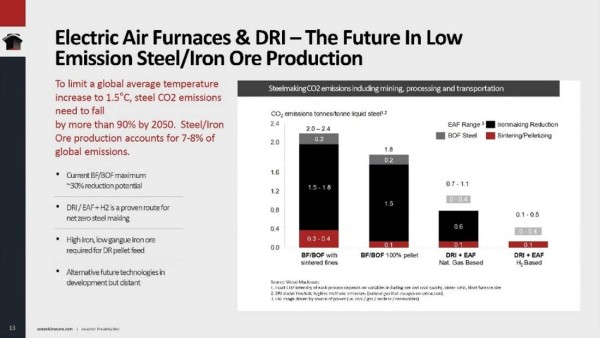
The production of steel is a major contributor to global warming. An astonishing one billion metric tonnes of metallurgical coal is consumed globally every year to manufacture steel. This accounts for 15% of coal burned globally across all industries. Steel and iron ore are responsible for 7-9% of the world’s CO2 emissions.
The United Nations Industrial Development Organization (UNIDO) has recommended that emissions from the iron and steel sector fall by more than 90% by 2050. To achieve this reduction target, global metallurgical infrastructure is currently being reimagined and rebuilt.
For decades, iron ore has been processed in traditional blast furnaces. These enormous chemical reactor towers transform iron ore into liquid metal (pig iron). The process requires extreme heat generated from burning metallurgical coke with hot air.
Blast furnaces are designed to run continuously 24/7 for 10 to 20 years. Shutting them down creates three major problems: the molten iron and slag inside the furnace can turn solid after time; cooling refractory linings can cause structural damage; reheating the blast furnace requires large amounts of energy, taking weeks – sometimes months – to achieve operational readiness.
Currently, about 70% of global steel is manufactured using these coal-fired blast furnaces. Gradually, production is being shifted to Direct Reduced Iron (DRI) plants that use Green Hydrogen to strip oxygen from the iron ore, releasing water vapour instead of CO2.
The benchmark grade of iron ore required for blast furnace product is 62% Fe. Impurities like phosphorus make the steel brittle. Removing other impurities such as silica, alumina and sulphur forces the steel mill to use more energy, pure oxygen and fluxing agents like limestone.
The greener DRI plants require high-grade iron ore with low impurities due to the electricity requirements to produce a molten slag during steel making. Our lead asset, Hopes Advance, produces 66.6% Fe iron ore, with 0.01% Al₂O₃ and 0.005% phosphorus – among the lowest impurity levels of any seaborne concentrate globally.
New environmental regulations are actively pushing Chinese steel mills toward higher-grade ores. The Chinese want processing facilities that will maximize output while minimizing the additional pollution created from removing impurities.
High-grade, low-impurity iron ore has been added to Canada’s and Québec’s Critical Minerals List. This premium product is in high demand from global steelmakers transitioning to green, hydrogen-based Direct Reduced Iron (DRI) processing.
Because the Hopes Advance iron ore is high-grade and has negligible alumina and phosphorus content, we have an opportunity to play an important role in servicing the green steel markets. It is a significant business advantage. Not all iron mines can contribute to the green steel input market.
There are still about 1,000 blast furnaces in operation. Many of these operations need high-grade material to blend with their lower-grade feed. Oceanic downstream iron ore buyers could be steel companies, iron ore producers, or trading houses.
In the next message, I will explain what we learned from the Hopes Advance Re-Scoped PEA.
By Chris Batalha
CEO of Oceanic Iron Ore
Click here to visit Oceanic Iron Ore’s website.
Contact: guy.bennett@globalstocksnews.com
Disclaimer: Oceanic Iron Ore paid Global Stocks News (GSN) $1,200 for the dissemination of this content.
Full Disclaimer: GSN researches and fact-checks diligently, but we cannot ensure our publications are free from error. Investing in publicly traded stocks is speculative and carries a high degree of risk. GSN publications may contain forward-looking statements such as “project,” “anticipate,” “expect,” which are based on reasonable expectations, but these statements are imperfect predictors of future events. When compensation has been paid to GSN, the amount and nature of the compensation will be disclosed clearly.
Media Contact
Organization: Global Stocks News
Contact Person: guy.bennett@globalstocksnews.com
Website: https://www.globalstocksnews.com
Email: Send Email
Country: Canada
Release id: 49782
The post Oceanic Iron Ore CEO Chris Batalha Talks About The Demand for Green Steel appeared first on King Newswire. This content is provided by a third-party source.. King Newswire makes no warranties or representations in connection with it. King Newswire is a press release distribution agency and does not endorse or verify the claims made in this release. If you have any complaints or copyright concerns related to this article, please contact the company listed in the ‘Media Contact’ section